
BREAKING NEWS: India Launches Nationwide Cell Broadcast Emergency Alert System: All You Need to Know
Alfaaz Point | May 3, 2026
In a massive technological leap for public safety and disaster management, the Government of India has officially launched the Nationwide Cell Broadcast System (CBS). Inaugurated by the Union Minister for Communications, Jyotiraditya Scindia, under the guidance of Union Home Minister Amit Shah, the system is designed to deliver near real-time, geo-targeted emergency alerts to citizens across the country.
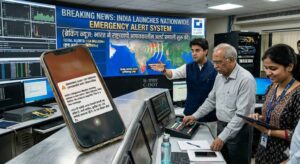
This launch marks a critical shift from a reactive to a proactive approach in safeguarding citizens against natural disasters and man-made emergencies.
What is the New Cell Broadcast System?
Developed indigenously by the Centre for Development of Telematics (C-DOT) under the Department of Telecommunications (DoT), in collaboration with the National Disaster Management Authority (NDMA), the CBS technology replaces the limitations of traditional SMS-based alerts during mass emergencies.
-
Targeted Delivery: Unlike standard SMS, cell broadcast reaches all mobile devices in a highly specific geographic area simultaneously.
-
Overcoming Network Congestion: The system remains highly reliable during emergencies and times of heavy network load, ensuring uninterrupted communication.
-
Integrated Framework: It operates over all generations of telecom networks—2G, 3G, 4G, and 5G—ensuring maximum reach across the country’s diverse terrain.
“The launch of the Cell Broadcast System marks a transformative step in India’s disaster management framework, reflecting our shift from a reactive to a proactive approach in safeguarding citizens.”
— Jyotiraditya Scindia, Union Minister for Communications
How the System Works in an Emergency
The platform is integrated with the SACHET platform, which has already been tested for standard weather alerts. During critical times, authorities can transmit priority notifications directly to mobile screens.
-
Priority Pop-ups: Emergency notifications appear as pop-up alerts right on the mobile screen.
-
Audio Override: The alert is accompanied by a loud alarm tone and vibration, designed to override “Silent” or “Do Not Disturb” (DND) modes.
-
Multilingual Capabilities: To ensure no individual is left behind, alerts are dispatched in English, Hindi, and respective regional languages depending on the location.
-
Geo-targeted Precision: Alerts can be sent to individual cell towers to warn only the specific population at risk.
Nationwide Test and Citizen Response
To test the resilience and efficiency of the new telecommunication infrastructure, a nationwide drill was conducted alongside the launch on May 2, 2026.
Millions of mobile users across all 36 States and Union Territories received an “Extremely Severe Alert” notification. The trial message read:
“Extremely Severe Alert: India launches Cell Broadcast using indigenous technology, for instant disaster alerting service for its citizens. Alert citizens, safe nation. No action is required by the public upon receipt of this message. This is a test message – Government of India.”
Officials at the NDMA and DoT have urged the public not to panic during these testing phases, as the system is merely being calibrated for high-stress scenarios.
National Preparedness and Global Standards
This indigenous solution places India among the top tier of nations with advanced public warning systems, aligning with the United Nations’ “Early Warnings for All” initiative.
-
Broad Disaster Coverage: The alerts will provide advance notice for time-critical situations such as tsunamis, earthquakes, flash floods, lightning strikes, and hazards like industrial gas leaks.
-
Compliance: The framework is based on the Common Alerting Protocol (CAP) recommended by the International Telecommunication Union (ITU).